Theralytics alternatives for ABA agencies (2026)
Theralytics is a BCBA-founded ABA practice-management and data-collection platform with rare pricing transparency and strong reviews, fitting cost-conscious small practices and new BCBAs. This page covers its strengths, recurring review themes, and how an AI-first alternative compares.
Theralytics is a BCBA-founded ABA practice-management and data-collection platform that is unusually transparent for this market: it publishes per-client pricing and holds a 4.8/5 rating on Capterra (108 reviews, as of July 2026). Agencies that go looking for alternatives usually are not fleeing the product — they have run into specific gaps reviewers on Capterra and Software Advice describe, such as mobile-app limitations, occasional crashes with lost notes, and missing assessment integrations. This page lays out the genuine strengths of the Theralytics platform, the recurring complaint themes from Capterra and Software Advice reviews, and how an AI-first platform like Coralia compares, so you can decide with clear eyes.
What Theralytics does well
Rare pricing transparency: Theralytics publishes its prices — $20/client/month for practice management or data collection alone or $30/client/month combined (10-client minimums apply; published per-user plans run $45/user/month), plus a BCBA Startup package (free for 6 months or until the first client lands, subject to published receivables-percentage terms) and no annual contract on standard plans (published, as of July 2026).
Founded by a Board Certified Behavior Analyst who previously owned multiple ABA organizations, so its workflows were designed from inside the field rather than adapted from generic healthcare software.
Highly rated by users: 4.8/5 from 108 reviews on Capterra as of July 2026, with reviewers repeatedly praising ease of use, fast staff onboarding, and a responsive support team; the same 4.8/108 profile appears on Software Advice (also as of July 2026).
Serious compliance posture for its price point: SOC 2 Type II compliant, ONC certified, and HIPAA compliant, hosted on AWS with two-factor authentication and encryption at rest and in transit.
A genuinely full suite in one product — scheduling, data collection with real-time graphing, billing and claims with clearinghouse integrations, generative-AI session-note narratives, an offline-capable mobile app, and an optional in-house billing/RCM service that Capterra reviewers single out for keeping cash flow consistent.
What reviewers consistently flag
The themes below are the recurring friction points in public reviews, each attributed to where it was observed.
Mobile app limitations
Capterra reviewers report missing administrative features in the mobile app, functions that cannot be completed app-only, and syncing delays between the app and the web browser.
Reported crashes and data loss
Capterra reviewers describe occasional crashes that caused note loss, connectivity problems, and saved data (including signatures) disappearing; reviewers also note these incidents were generally addressed efficiently by support.
Missing integrations and features
Capterra reviewers cite the lack of a goal bank integrated with VB-MAPP, ABLLS-R, or AFLS assessments, no Q-global integration, no built-in payroll function, limited document customization, and the inability to edit some saved data.
Workflow friction in specific areas
Capterra reviewers mention small icons that are not intuitive, an authorization process that needs simplification, and a signature workflow they find overly complex.
How Theralytics and Coralia charge
The billing model matters more than the sticker price: per seat, per active client, or per unit of work decides what growth costs you. Each figure below carries how it was sourced.
Theralytics
$20–30/client/mo or $30–45/user/mo; $200–300/mo minimum
Per client or per user (your choice)
Published by the vendor
No onboarding fees. Full-service billing at 4.5% of receivables discounts the software up to 100%.
Coralia
$39/client/mo all-in · $59 with Sentinel
Per active client — unlimited users
Published by the vendor
No per-seat fees, no setup fee, no annual escalator; ABA Matrix migration handled by our team.
Figures reviewed 2026-07-11; vendors change pricing without notice, so confirm on their site before you sign. All 15 platforms side by side →
How to evaluate an alternative
Whatever you choose — including staying — run the decision through ten criteria: size fit, all-in-one vs add-ons, data migration, contract terms, ai capabilities, compliance features, billing depth, point-of-care usability, support and onboarding, trial with real workflows.
The full evaluation framework, with what to ask on each point →
The landscape of alternatives
| Platform | Positioning | Best for |
|---|---|---|
| Coralia | AI-first all-in-one platform whose differentiator is autonomous compliance: Sentinel audits every day's session notes and a per-agency AI copilot works across scheduling, billing, and operations. | Small and mid-size agencies that want documentation audit-readiness built in, not bolted on. |
| CentralReach | The category's market leader with the broadest all-in-one enterprise suite: clinical data collection, scheduling, billing and claims, payroll, HR, analytics, and a learning/CEU platform in one ecosystem. | Large multi-site, multi-state organizations with complex billing hierarchies and internal admin teams. |
| ABA Matrix | Highly rated all-in-one (4.9/5 on Capterra as of July 2026) built for small ABA providers — scheduling, assessments, data collection, one-click billing, and payroll tied to schedules. | Small practices and startups that want everything connected out of the box. |
| AlohaABA | Practice-administration hub for scheduling, authorizations, billing, payroll, and receivables; pairs with data-collection partners via integrations. | Agencies whose main pain is admin and billing operations. |
| Motivity | Clinically driven platform with deeply flexible data collection and program building; practice-management features are newer additions. | Clinical-quality-first teams that want measurement flexibility. |
| RethinkBH | Connected clinical and practice management for pediatric behavioral health with strong built-in caregiver training content. | Mid-size organizations serving broader developmental populations. |
| Artemis ABA | Salesforce-based platform with AI-assisted scheduling and heavy revenue-cycle automation: eligibility checks, claim scrubbing, AR analytics. | Billing-heavy mid-size and larger organizations comfortable on Salesforce. |
| Raven Health | Modern, mobile-first data collection with scheduling, billing, and reporting, fully functional on iOS and Android. | Clinics prioritizing simple, reliable point-of-care mobile capture. |
| Noteable | Behavioral-health EHR spanning ABA plus mental health (4.7/5 across ~85 Capterra reviews as of July 2026), with managed billing services available. | Multi-disciplinary organizations adding mental-health services alongside ABA. |
| Office Puzzle | Flat-rate, all-inclusive ABA practice management from a Florida-based, founder-led company — $19.99 per user per month covers scheduling, documentation, data collection, billing, and payroll, with sessions tied to authorizations. | Small home- and community-based ABA agencies that want predictable per-user pricing, everything included, and hands-on onboarding without enterprise complexity. |
| Catalyst | Veteran ABA data-collection specialist (DataFinch, 2010), now sold as Ensora Data Collection within Ensora Health's ABA line; deep discrete-trial and skill-acquisition tooling with automatic graphing, typically paired with a separate practice-management and billing system. | Agencies that want deep, highly customizable clinical data collection with published reliability evidence and are comfortable running it alongside a separate practice-management system. |
| WebABA | WebABA (now Ensora ABA Suite) is the ABA practice-management arm of Ensora Health (formerly Therapy Brands): an established scheduling, billing, and authorization platform with optional managed billing and a companion data-collection product, rated 3.8/5 on Capterra (87 reviews, as of July 2026). | Agencies that want an ABA-specific system from a large, established vendor and value optional outsourced revenue cycle management. |
| Hi Rasmus | Clinical-first ABA platform from a Danish company founded in 2019 — deep flexible data collection (discrete trials through ABC data, with protocol-specific builds for ESDM, SBT, Balance, and SET), real-time and asynchronous telehealth supervision, and a BST-based 40-hour RBT training course. It deliberately does not replace the back office: it integrates with practice-management systems such as Camber, Lumary, Aloha ABA, Therapy PMS, and Boost. Rated 4.3/5 on Capterra (3 reviews, as of July 2026); pricing is quote-based and not published. | Agencies that prioritize clinical programming depth, remote/telehealth supervision, and structured parent training, and are comfortable running billing and practice management in a separate, integrated system. |
Where Coralia fits — and where it doesn't
If you are a new BCBA launching a practice on a tight budget, Theralytics is hard to argue against: its pricing is published and low, its free startup package removes the entry cost, and its 4.8/5 Capterra rating (as of July 2026) reflects a product users genuinely like. Coralia is built for agencies that have run into the specific gaps Theralytics reviewers name — no goal bank tied to VB-MAPP or ABLLS-R, no built-in payroll, missing assessment-tool integrations. In Coralia the assessment is the treatment plan, and payroll, scheduling, billing, and clinical work run inside one system rather than around it. On top of that single operation sits a daily audit of every session note (Sentinel) that routes corrections for human approval, plus a per-agency AI copilot across scheduling, billing, and operations. Judge the difference in the open live demo, no sales call required.
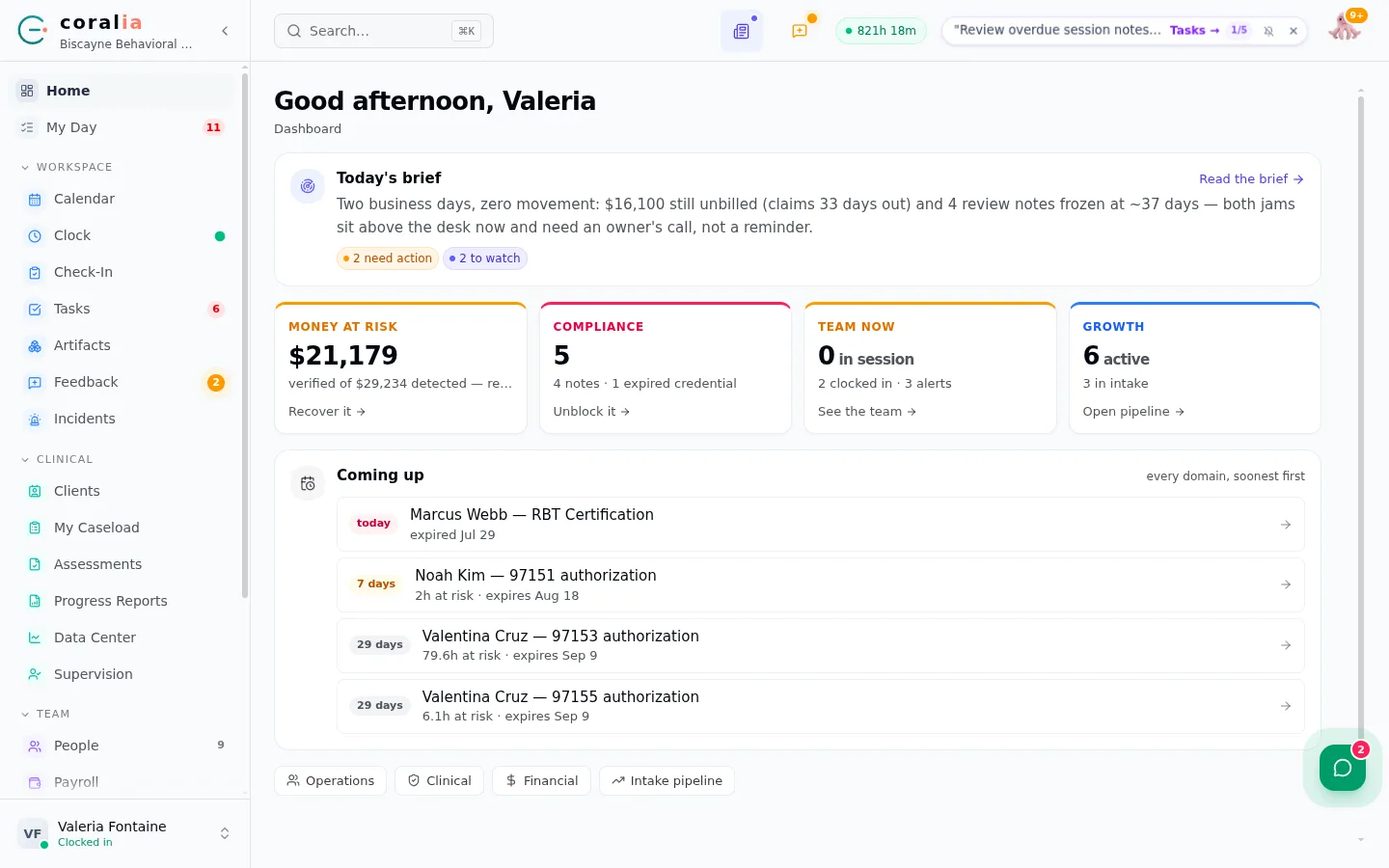
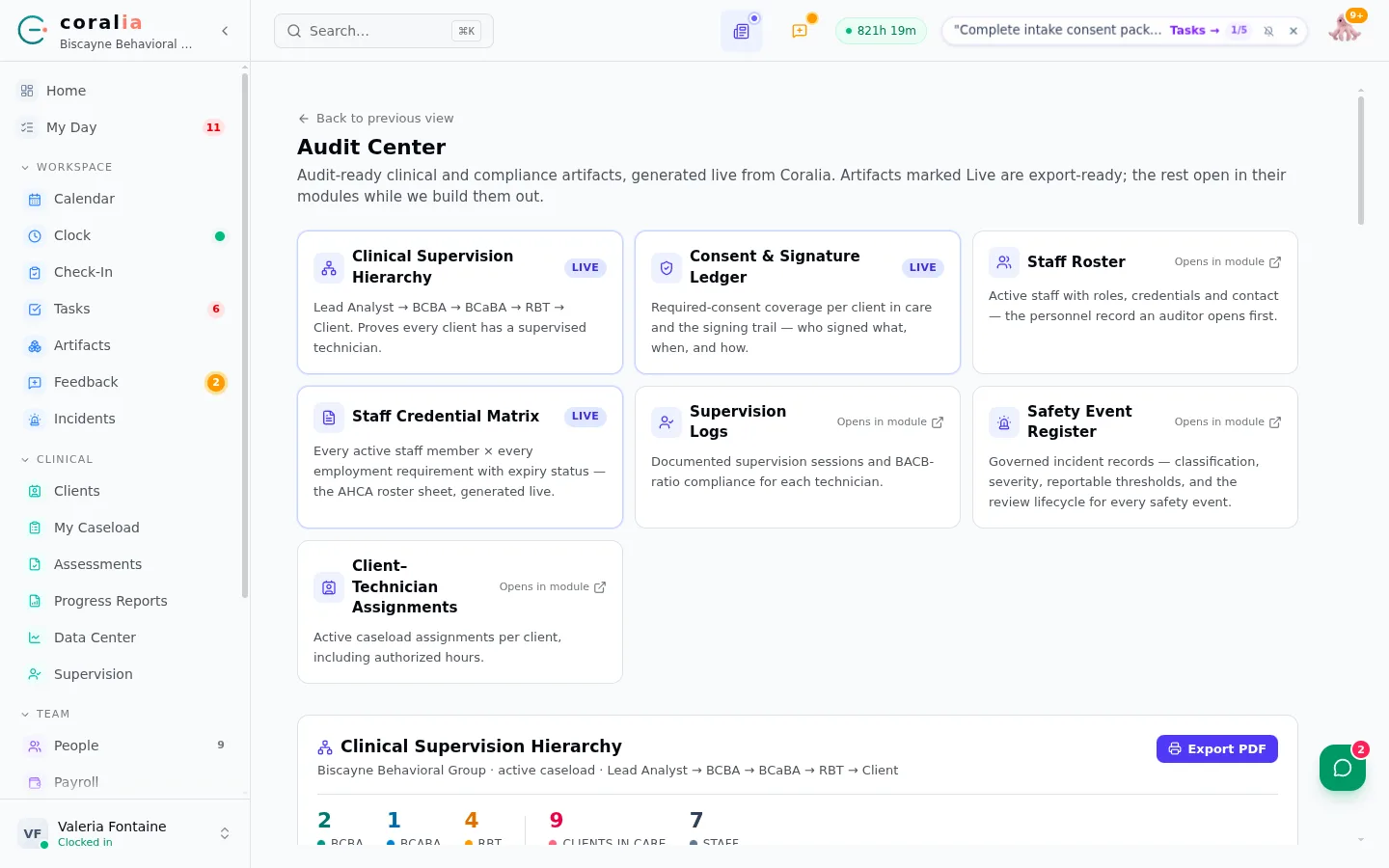
Every name, number, and note in these screens belongs to Biscayne Behavioral Group, the fictional agency in the demo. No real client data appears anywhere on this site.
Frequently asked questions
Is Theralytics a good product?
Yes — by the public evidence it is one of the best-liked products in the ABA software category. It holds 4.8/5 across 108 Capterra reviews as of July 2026, was built by a BCBA who ran ABA agencies, publishes its pricing openly, and carries SOC 2 Type II and ONC certification. The recurring criticisms on Capterra and Software Advice are about specific gaps — mobile-app limitations, occasional crashes with lost notes or signatures, and missing assessment-tool integrations — not about the product's fundamentals. The real question is fit: whether those specific gaps matter for how your agency works, and whether you also want an autonomous AI layer that audits each day's session notes with human approval.
What should a small ABA agency use instead of Theralytics?
It depends on what is driving the switch. Coralia is built specifically for small and mid-size ABA agencies and adds a different kind of AI layer: Sentinel, an autonomous auditor that reviews every day's session notes against a clinical documentation catalog and routes corrections for human approval, plus a per-agency AI copilot across scheduling, billing, and operations — and you can try a live demo at coralia.app/demo without a sales call. Other real alternatives worth evaluating: CentralReach if you are a larger organization that wants a very broad enterprise feature set, ABA Matrix if you want another practitioner-built all-in-one, and Motivity if clinical data collection is your priority.
How hard is it to migrate off Theralytics?
It is a manageable project, not a crisis. Theralytics standard plans have no long-term contract (published, as of July 2026), which removes the biggest structural obstacle to leaving. Plan for the usual ABA migration workload: exporting client demographics, authorizations, program/goal data, and historical session documentation; re-verifying payer and clearinghouse setup on the new system; and running a short parallel period so billing does not skip a cycle. The practical timeline for a small agency is typically weeks, driven mostly by how much historical clinical data you want to carry over versus archive. Ask any vendor you evaluate — Coralia included — to walk you through their data-import process against your actual export before you commit.
CentralReach, ABA Matrix, Theralytics, AlohaABA, Motivity, RethinkBH, Artemis ABA, Raven Health, Noteable, Office Puzzle, Catalyst, WebABA, Hi Rasmus are trademarks of their respective owners, used here only to identify the products. Coralia is not affiliated with or endorsed by any of them. Review figures are as of July 2026 and drift over time; verify current ratings and pricing on each vendor's site. This page is educational, not purchasing or legal advice.