AlohaABA alternatives for ABA agencies (2026)
AlohaABA is a well-reviewed, low-cost ABA practice-administration platform strong on scheduling, billing, payroll, and support, with a newer data-collection add-on. It fits lean practices whose main need is admin and billing. This page covers its strengths, review themes, and alternatives.
AlohaABA, built by Aloha Practice Management Inc, is a practice administration platform for ABA therapy organizations covering scheduling, billing and claims, payroll, authorization management and accounts receivable, with a newer data-collection add-on. It is one of the best-reviewed products in its category, holding 4.9/5 on Capterra as of July 2026, so agencies usually look for alternatives not because it fails but because they need deeper clinical tooling, a more mature data-collection layer, or more automation than a lean administrative system provides. This page summarizes AlohaABA's verified strengths, the recurring complaint themes on Capterra and Software Advice, and how to think about the alternatives.
What AlohaABA does well
Exceptional review scores: 4.9/5 from 64 reviews on Capterra as of July 2026 (Ease of Use 4.8, Customer Service 5.0, Features 4.6, Value for Money 4.8), with 98% of users saying they would recommend it; Software Advice shows the same 4.9/5 across 64 reviews as of July 2026. AlohaABA has no reviews on G2 as of July 2026.
Published, transparent pricing: $29.99 per staff member per month for Practice Management and $12 per client per month (currently discounted to $10) for the Data Collection add-on (published on alohaaba.com as of July 2026), with the vendor advertising no hidden fees and no implementation fee; reviewers also highlight month-to-month billing with no contracts.
Customer support is the single most-praised theme on Capterra and Software Advice: reviewers repeatedly describe responsive, personalized help, and the product carries a 5.0 Customer Service subscore on Capterra as of July 2026.
All-in-one practice administration built specifically for ABA: scheduling, claim submission with pre-scrub error checking and payer-level billing rules (including default modifiers), secondary claims through integrated clearinghouses, payroll, client portal, accounts receivable, and reporting, per the vendor's site.
Authorization management is integrated with scheduling and billing, with expiration alerts and utilization tracking designed to prevent scheduling beyond approved clinical limits; Capterra users voted it Best Value software for Applied Behavior Analysis in 2024.
What reviewers consistently flag
The themes below are the recurring friction points in public reviews, each attributed to where it was observed.
Calendar and scheduling limitations
A recurring theme on Capterra and Software Advice: several reviewers describe missing calendar capabilities (such as the lack of a monthly view), a cumbersome note-saving flow, and slow performance when navigating the calendar and scheduling screens.
Data collection module is young and limited
Reviewers on Capterra describe the data-collection product as new and not yet fully robust, with limited template options; Software Advice reviews similarly note the absence of built-in treatment plan and assessment templates and less depth than dedicated clinical data-collection tools.
Secondary billing and ERA workflow gaps
A small number of Capterra reviewers describe friction with secondary claims and ERA tracking, including workflows that route through external tools such as clearinghouse portals rather than being handled end to end inside the platform.
Requests for a dedicated mobile app
Individual reviewer accounts on Capterra (not a broad pattern) request a mobile app, for example so staff can view their schedules from a phone rather than a browser.
How AlohaABA and Coralia charge
The billing model matters more than the sticker price: per seat, per active client, or per unit of work decides what growth costs you. Each figure below carries how it was sourced.
AlohaABA
$29.99/staff/mo + $12/client/mo data collection
Per active staff + per-client add-on
Published by the vendor
No contract, no setup fees, 30-day trial. Managed billing service priced by quote.
Coralia
$39/client/mo all-in · $59 with Sentinel
Per active client — unlimited users
Published by the vendor
No per-seat fees, no setup fee, no annual escalator; ABA Matrix migration handled by our team.
Figures reviewed 2026-07-11; vendors change pricing without notice, so confirm on their site before you sign. All 15 platforms side by side →
How to evaluate an alternative
Whatever you choose — including staying — run the decision through ten criteria: size fit, all-in-one vs add-ons, data migration, contract terms, ai capabilities, compliance features, billing depth, point-of-care usability, support and onboarding, trial with real workflows.
The full evaluation framework, with what to ask on each point →
The landscape of alternatives
| Platform | Positioning | Best for |
|---|---|---|
| Coralia | AI-first all-in-one platform whose differentiator is autonomous compliance: Sentinel audits every day's session notes and a per-agency AI copilot works across scheduling, billing, and operations. | Small and mid-size agencies that want documentation audit-readiness built in, not bolted on. |
| CentralReach | The category's market leader with the broadest all-in-one enterprise suite: clinical data collection, scheduling, billing and claims, payroll, HR, analytics, and a learning/CEU platform in one ecosystem. | Large multi-site, multi-state organizations with complex billing hierarchies and internal admin teams. |
| ABA Matrix | Highly rated all-in-one (4.9/5 on Capterra as of July 2026) built for small ABA providers — scheduling, assessments, data collection, one-click billing, and payroll tied to schedules. | Small practices and startups that want everything connected out of the box. |
| Theralytics | Practice management plus data collection, BCBA-founded, SOC 2 Type II and ONC-certified, with transparent published pricing and no long-term contracts. | Cost-conscious small and mid-size practices that want predictable pricing. |
| Motivity | Clinically driven platform with deeply flexible data collection and program building; practice-management features are newer additions. | Clinical-quality-first teams that want measurement flexibility. |
| RethinkBH | Connected clinical and practice management for pediatric behavioral health with strong built-in caregiver training content. | Mid-size organizations serving broader developmental populations. |
| Artemis ABA | Salesforce-based platform with AI-assisted scheduling and heavy revenue-cycle automation: eligibility checks, claim scrubbing, AR analytics. | Billing-heavy mid-size and larger organizations comfortable on Salesforce. |
| Raven Health | Modern, mobile-first data collection with scheduling, billing, and reporting, fully functional on iOS and Android. | Clinics prioritizing simple, reliable point-of-care mobile capture. |
| Noteable | Behavioral-health EHR spanning ABA plus mental health (4.7/5 across ~85 Capterra reviews as of July 2026), with managed billing services available. | Multi-disciplinary organizations adding mental-health services alongside ABA. |
| Office Puzzle | Flat-rate, all-inclusive ABA practice management from a Florida-based, founder-led company — $19.99 per user per month covers scheduling, documentation, data collection, billing, and payroll, with sessions tied to authorizations. | Small home- and community-based ABA agencies that want predictable per-user pricing, everything included, and hands-on onboarding without enterprise complexity. |
| Catalyst | Veteran ABA data-collection specialist (DataFinch, 2010), now sold as Ensora Data Collection within Ensora Health's ABA line; deep discrete-trial and skill-acquisition tooling with automatic graphing, typically paired with a separate practice-management and billing system. | Agencies that want deep, highly customizable clinical data collection with published reliability evidence and are comfortable running it alongside a separate practice-management system. |
| WebABA | WebABA (now Ensora ABA Suite) is the ABA practice-management arm of Ensora Health (formerly Therapy Brands): an established scheduling, billing, and authorization platform with optional managed billing and a companion data-collection product, rated 3.8/5 on Capterra (87 reviews, as of July 2026). | Agencies that want an ABA-specific system from a large, established vendor and value optional outsourced revenue cycle management. |
| Hi Rasmus | Clinical-first ABA platform from a Danish company founded in 2019 — deep flexible data collection (discrete trials through ABC data, with protocol-specific builds for ESDM, SBT, Balance, and SET), real-time and asynchronous telehealth supervision, and a BST-based 40-hour RBT training course. It deliberately does not replace the back office: it integrates with practice-management systems such as Camber, Lumary, Aloha ABA, Therapy PMS, and Boost. Rated 4.3/5 on Capterra (3 reviews, as of July 2026); pricing is quote-based and not published. | Agencies that prioritize clinical programming depth, remote/telehealth supervision, and structured parent training, and are comfortable running billing and practice management in a separate, integrated system. |
Where Coralia fits — and where it doesn't
If what you need is affordable, well-supported practice administration and nothing more, AlohaABA is hard to beat: its Capterra scores, transparent published per-staff pricing (as of July 2026), and month-to-month terms make it the sensible default for a lean practice — switching would be a downgrade for that use case. Coralia is built for a different problem: small and mid-size agencies where the owner is also the compliance department and things slip through unwatched. Where AlohaABA is admin-first with a young data-collection module, Coralia puts clinical documentation and administration in one system and then watches it — a daily audit of every session note (Sentinel) that routes corrections for human approval, so quality is checked continuously instead of at audit time — with a per-agency AI copilot across scheduling, billing, and operations. Compare directly in the open live demo, no sales call required.
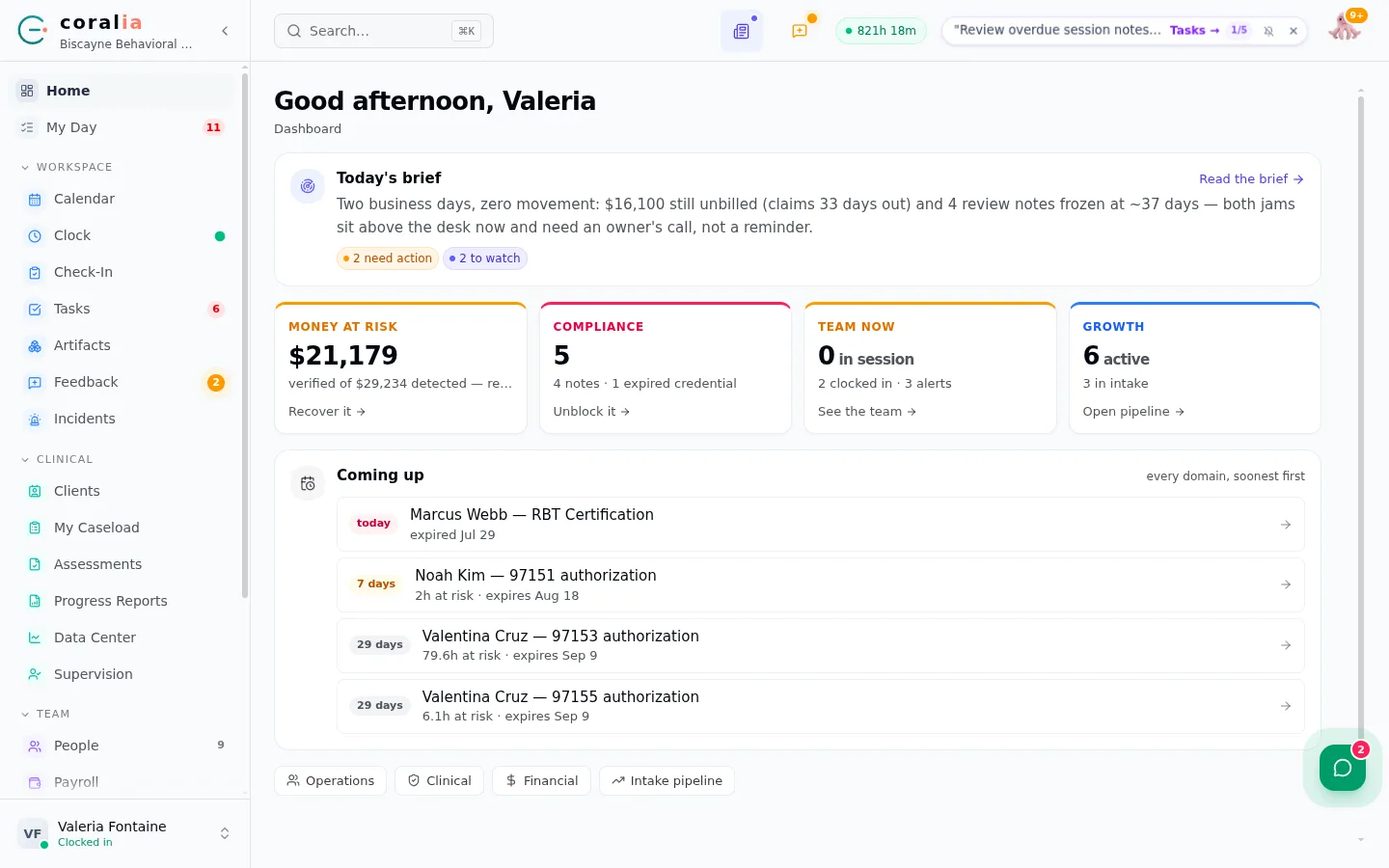
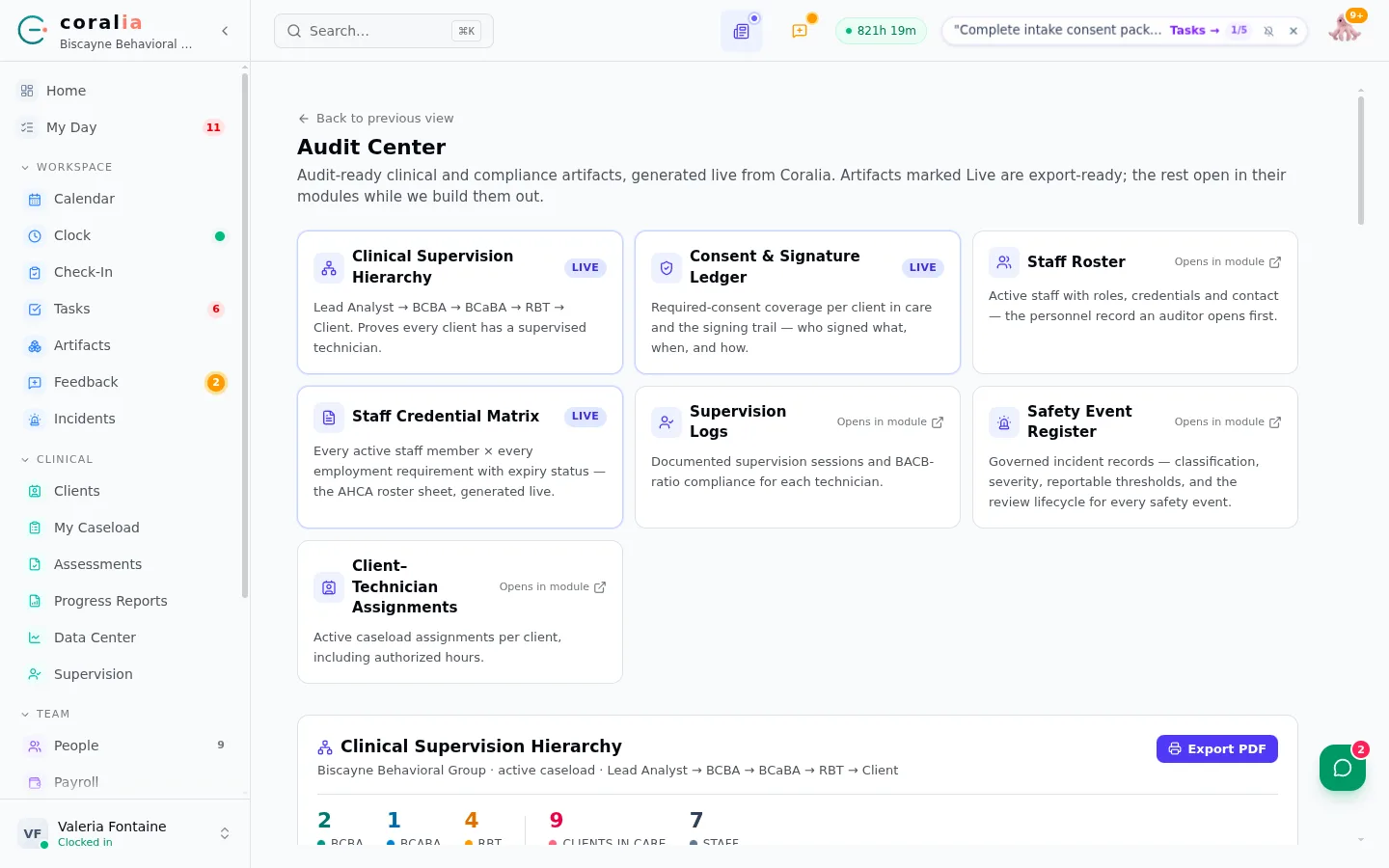
Every name, number, and note in these screens belongs to Biscayne Behavioral Group, the fictional agency in the demo. No real client data appears anywhere on this site.
Frequently asked questions
Should agencies avoid AlohaABA?
No. By public review measures it is one of the strongest products in ABA practice management: 4.9/5 across 64 Capterra reviews as of July 2026, a 5.0 Customer Service subscore, and a Capterra Best Value badge for 2024. Its published pricing ($29.99 per staff member per month as of July 2026) is transparent and low relative to enterprise suites. The framing that matters is fit, not quality: AlohaABA is a lean administrative system, and the recurring critiques on Capterra and Software Advice concern calendar limitations, a young data-collection module, and secondary-billing workflow gaps rather than fundamental reliability problems. Agencies that outgrow it typically need deeper clinical documentation and more automation, not a replacement for something broken.
What should a small ABA agency use instead of AlohaABA?
It depends on what is driving the switch. Coralia is built for small and mid-size ABA agencies that want AI to carry more of the operational load: it includes Sentinel, an autonomous auditor that reviews every day's session notes against a clinical documentation catalog and routes corrections for human approval, plus a per-agency AI copilot across scheduling, billing and operations, and an open live demo at coralia.app/demo with no sales call. Theralytics is another all-in-one option frequently compared with AlohaABA. CentralReach is the enterprise-grade suite if you need the deepest feature set, and Motivity is a strong choice if your main gap is dedicated clinical data collection layered on top of an administrative system.
How hard is it to migrate off AlohaABA?
Moderate, and mostly about planning rather than technology. The core records you need to move are client demographics and insurance details, active authorizations with remaining units, staff credentials and pay structures, scheduling templates, and your open accounts-receivable balances. Reviewers highlight month-to-month billing with no contracts, which suggests there is usually no long lock-in period, but verify the terms of your own agreement before planning a cutover. The practical approach is to run the two systems in parallel for one billing cycle: keep submitting in-flight claims from AlohaABA until they finish adjudicating, start new sessions and claims in the new system on a clean cutover date, and export reports and documentation you may need for future payer audits before closing the account. Expect the transition to take a few weeks of attention from whoever owns billing, not months.
CentralReach, ABA Matrix, Theralytics, AlohaABA, Motivity, RethinkBH, Artemis ABA, Raven Health, Noteable, Office Puzzle, Catalyst, WebABA, Hi Rasmus are trademarks of their respective owners, used here only to identify the products. Coralia is not affiliated with or endorsed by any of them. Review figures are as of July 2026 and drift over time; verify current ratings and pricing on each vendor's site. This page is educational, not purchasing or legal advice.